

 Post by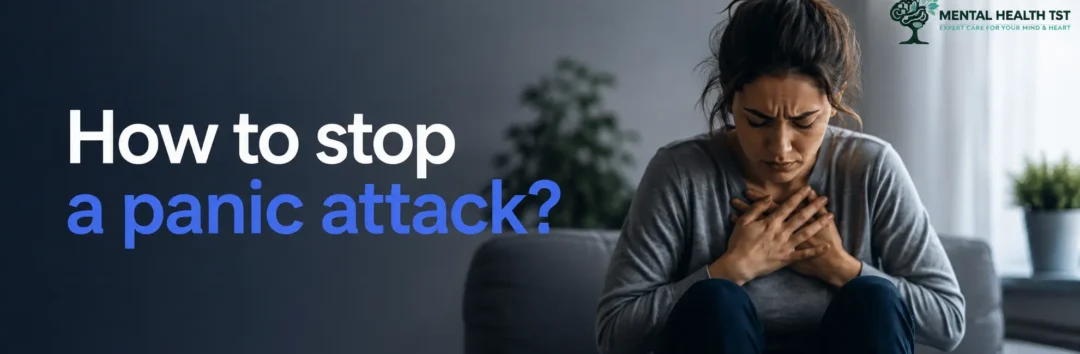
How to Stop a Panic Attack: What to Do?
Learn how to stop a panic attack, calm intense symptoms, understand what causes panic, and discover when professional anxiety support may help.
Have you ever felt completely fine one minute and then suddenly felt like something was terribly wrong?
Your heart starts pounding. Your breathing feels strange. Your chest may feel tight. You might become dizzy, shaky, sweaty, or suddenly afraid that you are going to lose control. And because the physical sensations can feel so intense, your mind may immediately jump to the worst possible explanation.
That is what makes a panic attack so frightening.
A panic attack can arrive quickly and make an ordinary situation feel like an emergency. The experience is very real, even when there is no immediate danger around you. Learning how to stop a panic attack is not about forcing yourself to calm down instantly. It is about understanding what is happening, reducing the fear surrounding the symptoms, and giving your body an opportunity to settle.
The encouraging part is that panic attacks can be managed. With the right strategies and, when needed, professional treatment, people can learn to respond differently when panic appears.
What Is a Panic Attack?
A panic attack is a sudden episode of intense fear or discomfort that can happen even when there is no obvious danger. It can cause both emotional and physical symptoms, including a racing heart, sweating, trembling, dizziness, nausea, chest discomfort, shortness of breath, tingling, and a strong fear of losing control or dying. (National Institute of Mental Health)
The symptoms can be so powerful that some people believe they are having a heart attack or another serious medical emergency.
That fear can then make the physical sensations even stronger.
Think of it as an alarm system that has become extremely sensitive. Your body’s alarm is trying to protect you, but it can sometimes react as though there is an immediate threat when there isn’t one.
A single panic attack does not automatically mean you have panic disorder. Panic disorder involves recurrent, unexpected panic attacks along with ongoing worry about having another attack or significant changes in behavior because of the attacks. (National Institute of Mental Health)
That distinction matters because panic attacks can happen for different reasons, and not everyone who experiences one will develop panic disorder.
Why Does a Panic Attack Happen?
To understand how to stop a panic attack, it helps to understand what your body is doing in the first place.
Your nervous system has a built in threat response. When your brain believes you may be in danger, it can activate a fight or flight response. Your heart beats faster, your breathing changes, your muscles become more prepared for action, and your attention becomes focused on potential danger.
This response can be extremely useful when you actually need to escape from danger.
But panic can occur when the alarm response becomes activated without an immediate physical threat.
Sometimes there is an obvious trigger, such as being in a crowded place, driving, experiencing a stressful situation, or thinking about something frightening. At other times, a panic attack seems to come completely out of nowhere.
Researchers believe that biological processes, genetics, stress, and environmental factors can all contribute to panic disorder. NIMH describes panic attacks as a kind of false alarm in which normal survival responses may become activated too strongly or too often. (National Institute of Mental Health)
There is another important part of the picture.
You may notice your heart racing and think, “Something is seriously wrong.”
That thought creates more fear.
The additional fear creates more physical arousal.
You notice the stronger sensations and become even more frightened.
Suddenly, the original sensation is no longer the only problem. Your interpretation of that sensation has become part of the panic cycle.
What Does a Panic Attack Feel Like?
Panic attacks can look different from one person to another.
Some people mainly experience intense physical sensations. Others experience overwhelming fear, a feeling of unreality, or a sense that they are about to lose control.
Common symptoms can include:
• Rapid or pounding heartbeat
• Sweating
• Trembling or shaking
• Shortness of breath
• Chest discomfort
• Dizziness or weakness
• Chills or feeling unusually hot
• Nausea or stomach discomfort
• Tingling or numbness
• Fear of dying
• Fear of losing control
• Feeling detached from yourself or your surroundings
NIMH notes that panic attacks can occur at any time, including during sleep, and can last from several minutes to an hour or sometimes longer. (National Institute of Mental Health)
The intensity can make the episode feel endless, even though the peak of a panic attack often passes much sooner.
How to Stop a Panic Attack When It Starts?
There is no guaranteed technique that instantly switches off every panic attack. The goal is to reduce the intensity, avoid adding more fear to the situation, and allow the body’s alarm response to settle.
Here are several strategies that may help.
Remind Yourself That You Are Experiencing Panic
One of the first things you can do is name what is happening.
Instead of immediately thinking, “Something terrible is happening,” try telling yourself:
“I am experiencing a panic attack.”
“This feels frightening, but I can get through it.”
“My body is reacting to fear.”
“This feeling will eventually pass.”
This does not mean you should automatically assume every episode of chest pain or breathing difficulty is anxiety. New or severe symptoms should be medically evaluated when appropriate.
But if you have previously been assessed and know that you experience panic attacks, recognizing the pattern can prevent your mind from turning every physical sensation into another emergency.
Cleveland Clinic recommends acknowledging the panic and reminding yourself that the episode is temporary as one way to manage the fear surrounding the symptoms. (Cleveland Clinic)
Slow Down Your Breathing
Breathing often changes during panic. You may begin breathing rapidly or taking larger breaths because your body feels threatened.
That can make sensations such as dizziness, tingling, or breathlessness feel even more frightening.
Rather than forcing yourself to take enormous breaths, focus on making your breathing gentle and slower.
Try breathing in comfortably through your nose and then breathing out slowly. Let your abdomen move naturally as you breathe rather than deliberately taking extremely large breaths.
You can place one hand on your stomach and notice its movement.
The goal is not to achieve perfect breathing.
The goal is to stop fighting your breath and give your nervous system a calmer signal.
Controlled breathing can help reduce symptoms associated with panic and hyperventilation. (Cleveland Clinic)
Stop Fighting Every Sensation
This may sound strange when you are frightened, but constantly checking whether your heart has slowed down or whether your dizziness has disappeared can keep your attention locked onto the symptoms.
Try noticing the sensations without immediately reacting to them.
Your heart is beating quickly.
Okay.
Your hands are trembling.
Okay.
Your chest feels uncomfortable.
Notice it.
You do not have to like the sensation. You are simply allowing it to exist without treating every feeling as proof that something catastrophic is happening.
This approach can take practice, especially when your body feels extremely uncomfortable.
Use Grounding to Bring Your Attention Back
Panic can pull your attention into frightening predictions about what might happen next.
Grounding gives your mind something concrete to focus on.
Look around the room and notice what you can see.
Feel your feet against the floor.
Notice the temperature of the air.
Listen for sounds around you.
Describe an object in detail.
You can also slowly name several things you can see, hear, and physically feel.
The purpose is not to distract yourself from reality. It is to remind your brain that you are here, in the present moment, rather than inside the frightening scenario your anxious mind is predicting.
Use a Simple Calming Statement
When panic begins, complicated reasoning may be difficult.
Prepare a short statement before you actually need it.
Something like:
“I have felt this before.”
“I can handle this moment.”
“I do not need to solve everything right now.”
“I can let this feeling pass.”
Cleveland Clinic recommends preparing a reassuring script that can be kept somewhere accessible and used during an attack. (Cleveland Clinic)
The statement does not have to convince you that everything is wonderful.
It only needs to stop your thoughts from automatically moving toward catastrophe.
Move Somewhere Comfortable If You Can
If you are in a crowded, noisy, or overwhelming environment, moving somewhere quieter may make it easier to focus on your breathing and surroundings.
If you are driving, pull over somewhere safe.
If you are at work, you may be able to step into a quieter area.
If you are at home, sit somewhere comfortable.
The purpose is not to permanently avoid situations that make you anxious. That can sometimes reinforce anxiety over time.
Instead, give yourself enough space to regain control and then consider returning to normal activities when it is safe and appropriate.
What Should You Avoid During a Panic Attack?
When panic appears, it is natural to want to do something immediately to make the feeling disappear.
However, some reactions can unintentionally strengthen the cycle.
Try not to repeatedly check your pulse, search your symptoms online, or constantly ask yourself whether something is medically wrong if you have already been evaluated and know you are experiencing panic.
You should also be cautious about using alcohol or other substances as a way to manage panic. They may provide temporary relief but can create additional problems and may worsen anxiety over time.
Most importantly, do not shame yourself for having an attack.
Panic is not a character flaw.
It is a powerful fear response.
How to Reduce Future Panic Attacks?
Knowing how to stop a panic attack is useful, but long term improvement often involves understanding why attacks are happening and changing the patterns that keep fear going.
Learn Your Triggers
After an attack, write down what was happening before it began.
Were you exhausted?
Had you consumed a lot of caffeine?
Were you under unusual stress?
Had you been avoiding something?
Were you worried about a physical sensation?
Were you somewhere that had triggered panic before?
You may notice patterns that were not obvious during the attack.
Not every panic attack has a clear trigger, so do not pressure yourself to find one every time.
Work on Avoidance
Avoidance can provide immediate relief.
If a shopping center makes you anxious, staying home feels safer.
If driving triggers panic, asking someone else to drive feels easier.
If social situations make you nervous, canceling plans removes the discomfort.
The problem is that repeated avoidance can teach your brain that the situation really is dangerous.
Over time, your world can become smaller.
A mental health professional can help you gradually approach feared situations in a structured and manageable way. Exposure based approaches are commonly used within CBT for panic and anxiety disorders. (National Institute of Mental Health)
Look at Sleep, Stress, and Stimulants
Your overall physical state can influence how vulnerable you feel to anxiety.
Poor sleep can make it harder to manage stress. High levels of ongoing stress can keep your nervous system more activated. Caffeine can increase alertness and may make sensations such as a racing heartbeat more noticeable.
You do not need to create a perfect lifestyle.
Instead, focus on the basics.
Aim for consistent sleep, regular physical activity, balanced meals, and time to decompress. NIMH also recommends healthy habits such as adequate sleep, exercise, healthy eating, and maintaining supportive relationships as part of caring for mental health. (National Institute of Mental Health)
When Should You Seek Professional Help?
An occasional panic attack can be frightening, but recurring attacks deserve attention, especially when they begin changing the way you live.
You may need professional support if you constantly worry about having another attack, avoid places because you are afraid of panicking, struggle to work or socialize, or spend a significant amount of time monitoring your body for symptoms.
Panic disorder is treatable.
Cognitive behavioral therapy is one of the most established treatments for panic disorder. CBT can help you understand anxious thoughts, change your responses to physical sensations, and gradually face situations you have been avoiding. (National Institute of Mental Health)
Medication may also be appropriate for some people. NIMH notes that treatment for panic disorder can include psychotherapy, medication, or a combination depending on the individual’s needs and medical situation. (National Institute of Mental Health)
You do not have to figure out the right treatment alone.
A psychiatrist, psychologist, therapist, or primary care professional can help determine what may be happening and what options are appropriate.
If symptoms are new, severe, or different from what you have experienced before, do not automatically assume they are panic. Chest pain, serious breathing difficulty, fainting, or other concerning symptoms may require urgent medical evaluation.
If you are experiencing thoughts of suicide or self harm, seek immediate help. In the United States, you can call or text 988 for the Suicide and Crisis Lifeline. In a life threatening emergency, call 911. (National Institute of Mental Health)
Frequently Asked Questions About Panic Attacks
How can I calm a panic attack quickly?
There is no guaranteed instant way to stop every panic attack. You can try slowing your breathing, grounding yourself in the present, relaxing tense muscles, using a reassuring statement, and reminding yourself that the episode is temporary. These strategies can reduce the fear surrounding the physical sensations while your body’s alarm response settles. (Cleveland Clinic)
How long does a panic attack last?
Panic attacks vary in duration. Symptoms often reach their strongest point within several minutes and then begin to decrease, although some people may continue experiencing symptoms for longer. (Cleveland Clinic)
Why do panic attacks feel like a heart attack?
Panic activates the body’s threat response, which can produce a racing heart, chest discomfort, sweating, shaking, and difficulty breathing. Because these symptoms overlap with some medical conditions, new or unexplained symptoms should not automatically be assumed to be panic. A healthcare professional can help determine the cause.
Can panic attacks go away?
Yes. Panic attacks and panic disorder can be treated, and many people learn to manage or significantly reduce their symptoms. CBT, exposure based approaches, medication when appropriate, and healthy lifestyle habits can all play a role in treatment. (National Institute of Mental Health)
You Are Not Powerless When Panic Appears
A panic attack can make you feel as though your body has taken control away from you.
Your heart races.
Your breathing changes.
Your thoughts become frightening.
For a few moments, everything can feel urgent.
But a panic attack is a powerful fear response, not proof that you are incapable of handling life.
Learning how to stop a panic attack is really about learning how to respond differently when your body’s alarm system becomes activated. You can learn to recognize the sensations, slow your breathing, question catastrophic thoughts, ground yourself, and stop treating every uncomfortable feeling as an emergency.
If panic attacks are becoming frequent or interfering with your life, professional support can make a meaningful difference. You do not need to wait until your anxiety becomes unbearable before reaching out.
Mental Health First is a mental health practice focused on personalized psychiatric care for adults dealing with concerns such as anxiety, depression, ADHD, PTSD, insomnia, and mood related conditions. The practice provides in person care in Miami Lakes and telepsychiatry services for adults throughout Florida.
You can learn more about Mental Health First through its official website and explore its mental health services to see what type of support may be appropriate for you.
And if another panic attack happens, remember this: you do not have to make the fear disappear instantly. You only need to take the next calm breath, notice the next moment, and let your body begin doing what it already knows how to do.
External Resources
For reliable information about panic disorder, symptoms, and treatment, visit National Institute of Mental Health: Panic Disorder.
For practical guidance on managing panic symptoms, visit Cleveland Clinic: How to Stop a Panic Attack.