

Depression Treatment in Miami Lakes, FL
Depression can affect your energy, sleep, relationships and ability to manage everyday life. At Mental Health First, we provide depression treatment for adults in Miami Lakes, FL, with time to understand what you’re experiencing and discuss your options. Your care begins with a thorough evaluation by a board-certified psychiatric nurse practitioner, followed by a personalized treatment plan that may include medication management and ongoing follow-up visits to review your progress and adjust your care. Visit our Miami Lakes office or access secure telepsychiatry from anywhere in Florida, with appointments available in English and Spanish and same-week availability to help you get started sooner.
What Is Depression, and How Is It Different From Feeling Down?
Depression is a medical condition that affects mood, energy, sleep, appetite and concentration. Doctors diagnose major depression when a person has at least five of nine listed symptoms for two weeks or longer, and one of them is low mood or loss of interest. The National Institute of Mental Health reports that about 8% of US adults have a major depressive episode in a given year.
Feeling down passes. A bad week after a breakup or a rough stretch at work eases when things change. Depression does not. It stays on good days too, and it gets in the way of work, relationships and basic tasks like eating or showering. See depression vs sadness and burnout or depression.
It does not always look like sadness. Some people feel flat, numb or irritable. Some keep working and looking after their family while feeling nothing inside. That pattern is covered in our article on high functioning depression.
Physical symptoms are common. Fatigue, headaches, stomach problems and aches with no clear cause often send people to a primary care doctor before anyone mentions mood.
Types of Depression We Treat in Miami Lakes
We evaluate and treat these types of depression at our Miami Lakes office. The type affects how treatment starts and how long it lasts.
Major Depressive Disorder (MDD)
Low mood or lost interest lasting two weeks or longer, with changes in sleep, appetite, energy or focus. Episodes range from mild to severe and can return.
Persistent Depressive Disorder (Dysthymia)
Low grade depression lasting two years or longer. It is easy to miss because it becomes the normal state. It responds to treatment but often needs longer follow up.
Seasonal Affective Disorder (SAD)
Depression that starts around the same time each year, usually in fall or winter, and lifts in spring. Treatment is often timed around the season.
Postpartum Depression
Depression that starts during pregnancy or in the year after birth. It is more intense and lasts longer than the baby blues, and it needs an evaluation.
Treatment-Resistant Depression
Depression that has not improved after two or more antidepressants taken at a full dose for long enough. A review of past trials often finds options not yet tried.
Depression with Anxious Distress
Depression with constant tension, restlessness or worry. It is common and can be harder to treat. Our anxiety treatment page covers the anxiety side.
Signs and Symptoms of Depression in Adults
Several of these together, lasting two weeks or longer, are a reason to book an evaluation. One or two bad days are not.
A common pattern: you cancel plans for the third time, a 20 minute task sits for days, and you wake at 4 a.m. unable to get back to sleep.
- Feeling sad, empty or hopeless most days
- Losing interest in things you used to enjoy
- Sleeping much more or much less than usual
- Changes in appetite or weight
- Constant tiredness, even after rest
- Trouble concentrating or making decisions
- Feeling worthless or guilty over small things
- Irritability or a short temper
- Pulling away from friends and family
- Slowed movement or speech, or restlessness
- Aches and pains with no clear physical cause
- Thoughts of death or of hurting yourself
When to See a Provider for Depression
See a provider if low mood, loss of interest or other symptoms last two weeks or longer, or if they get in the way of work, school, family or self care.
Book sooner if symptoms keep coming back, if treatment from your primary care doctor has not helped, if you are using alcohol or other substances to cope, or if depression comes with anxiety, panic or trouble sleeping.
Primary care doctors treat many cases of depression. A psychiatric provider is the better fit when the diagnosis is unclear, when first treatments have not worked, or when another condition is involved. Read when should you see a psychiatrist for more on that choice.


How We Diagnose Depression in Miami Lakes
Depression is diagnosed through a clinical interview. There is no blood test or scan for it.
At a depression evaluation in Miami Lakes, the provider asks when symptoms started, how long they last, and how they affect sleep, appetite, work and relationships. She also asks about past episodes, past treatment, family history and any thoughts of self harm. A short questionnaire such as the PHQ-9 is often used to score symptoms. It does not replace the conversation.
Other causes get checked. Thyroid problems, low vitamin levels, sleep apnea, some medications and alcohol or drug use can look like depression. Bipolar disorder is screened for too, because the treatment is different. See our bipolar disorder page.
At the end you hear which type of depression fits, how severe it is and what the options are.
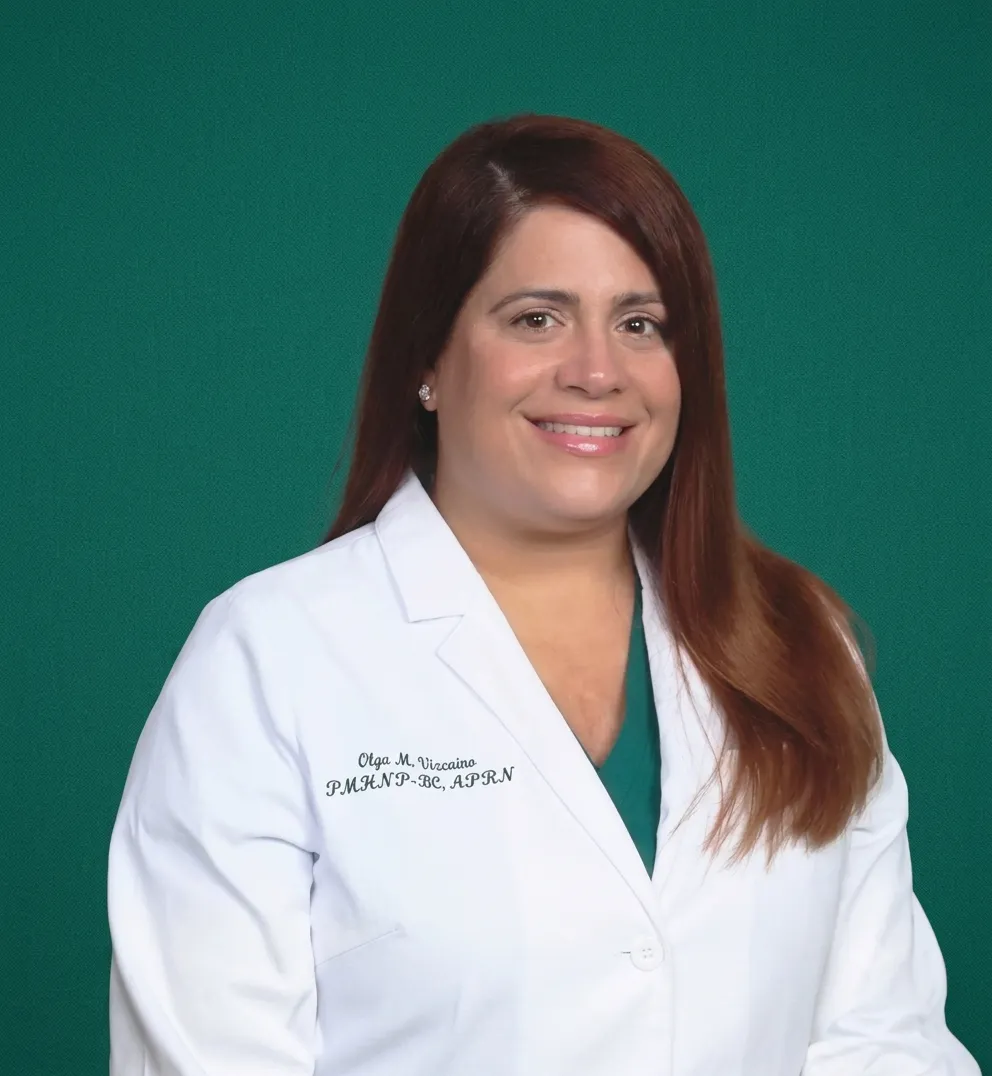
Meet Olga Vizcaino, PMHNP-BC
Ms. Olga Vizcaino is an experienced adult psychiatric and mental health nurse practitioner at Mental Health 1st, in Miami Lakes, FL. She offers both in-person and virtual care, combining clinical expertise with a thoughtful, patient centered approach. She earned her Bachelor’s degree and Master’s in Family Psychiatric and Mental Health Nursing from West Coast University in Miami.
Ms. Vizcaino provides comprehensive care for adults experiencing anxiety, depression, ADHD, PTSD, insomnia, and mood related concerns. Her approach emphasizes compassionate listening, open communication, and collaborative decision making, creating a calm and supportive space where patients feel heard and respected.
She focuses on understanding the whole person, not just symptoms, and develops tailored treatment plans designed to support emotional stability, daily functioning, and long term mental wellness. Ms. Vizcaino believes healing is about progress, and she is committed to empowering each patient throughout their mental health journey.
Ms. Olga Vizcaino proudly offers bilingual psychiatric care in English and Spanish.
Trusted by Patients.
Driven by Compassion.
EXCELLENT Based on 9 reviews
 Posted on Google

 ANGEL LORESMuy buena experiencia. Dr Olga Vizcaino es muy profesional. 100% recomendadaPosted on Google
 Orlando AlfonsoPosted on Google
 Damian VazquezPosted on Google
 Dayan VazquezPosted on Google
 Laiset MejiasPosted on Google
 Numancia VizcainoI felt heard and included in the desicion making of my treatment. I had a great experience.Posted on Google
 Magalis VizcainoPosted on Google
 Maria VeneroPosted on Google
 Deney Navarro

What Causes Depression and Who Is at Risk?
Depression usually has more than one cause. Research points to a mix of genes, brain circuits that handle mood, sleep and stress, life events, and physical health.
Family history. A parent or sibling with depression raises the risk. It does not decide it.
Life events. Loss, job stress, divorce, money problems, trauma and long periods of pressure can set off an episode. Sometimes nothing obvious happened.
Health and hormones. Chronic pain, thyroid problems, diabetes, heart disease, and hormone changes after childbirth or during menopause are linked to depression. Some medications can also cause low mood.
Women are diagnosed more often than men. Anxiety, ADHD, sleep disorders and past trauma often sit alongside depression, and treating only one can leave symptoms behind. See why mental health conditions get confused.
Depression Treatment Options at Mental Health First
Medication Management
Antidepressants are the most common medication for depression and come in several classes. Many take 4 to 8 weeks to show full effect. See our medication management page.
Treatment depends on the type of depression, how severe it is, your health history and what you prefer.
Ongoing Psychiatric Care
Visits are closer together at the start, often every few weeks, then spread out as symptoms improve. Doses, side effects and progress are reviewed at each visit.
In Person and Telepsychiatry Appointments
Visit our Miami Lakes office or use telepsychiatry by secure video from anywhere in Florida. The care is the same either way, and same week appointments are available.

Depression Treatment by Severity: Mild, Moderate and Severe
Severity decides where treatment starts.
Mild. Symptoms are there, but you can still work and function. Care may start with a lighter plan and a recheck in a few weeks.
Moderate. Symptoms affect work, relationships or sleep on most days. Medication is more often part of the plan, with follow ups every few weeks.
Severe. You can barely get through the day, or you are having thoughts of self harm. This needs faster and closer follow up.
A usual first three months: evaluation in week one, a check at four to six weeks for side effects and early response, and a review at eight to twelve weeks to decide whether to continue or change.
Antidepressants for Depression: Classes, Timing and Side Effects
Antidepressants are medications that act on the brain circuits that handle mood. Several classes are used. SSRIs and SNRIs are the most common starting points, and other classes are used when those do not fit.
The choice depends on your symptoms, other conditions, other medications, how you responded before and which side effects you want to avoid. Anxiety, poor sleep or low energy can all steer it.
Most antidepressants need 4 to 8 weeks at a steady dose. Nausea, headache, sleep changes and sexual side effects are common early on and often ease. Report them. Do not stop on your own.
Stopping an antidepressant suddenly can cause withdrawal symptoms and a return of depression. Doses are lowered step by step.
If the first medication does not work or causes problems, the dose, the medication or the combination can change. Switching is common. Read what is psychiatric medication management to see how follow up works.

Why Choose Mental Health First for Depression Treatment in Miami Lakes
Depression treatment at Mental Health First starts with a full history and continues with regular follow ups. You see the same provider each time, with same week appointments and secure video visits across Florida.
Your first depression evaluation covers symptoms, past treatment, medical history and goals before any decision is made.
If something is not working, the approach changes. Doses and medication choices are reviewed at each follow up.
Depression often comes with anxiety, sleep problems or medical conditions. These are reviewed in the same visit.
Insurance Accepted for Depression Treatment in Miami Lakes
We work with several insurance plans, and our team checks your benefits before your first visit. Not sure if your plan covers a depression evaluation, medication management or telepsychiatry visits? Call 954-620-8808 and we will check. See the full list on our insurance page.










Depression Treatment for Adults in Miami Lakes and Nearby Cities
Mental Health First is at 6001 NW 153rd St, Suite 203, Miami Lakes, FL 33014. The office serves adults from Miami Lakes and nearby areas such as Hialeah, Miami Gardens, Opa-locka, Doral, Miramar and Pembroke Pines.
If the drive is the problem, telepsychiatry for depression works too. Video visits are open to adults located anywhere in Florida, and the evaluation and follow ups are the same.
Visits are in English or Spanish. To book, call 954-620-8808 or use the form below.
How Depression Treatment Works at Mental Health First
1. Book Your Depression Evaluation
Call 954-620-8808 or fill out the form. Choose our Miami Lakes office or a video visit. Same week appointments are available.
2. Get a Clear Diagnosis
Your provider reviews symptoms, history and past treatment, then tells you which type of depression fits and how severe it is.
3. Start Treatment
You agree on a starting point, such as medication, and set a date for the first follow up. Changes are made as you go.
Start Depression Treatment in Miami Lakes Today
Fill out the form below or call 954-620-8808. Our team will contact you to find a time this week.
Questions About Depression Treatment in Miami Lakes
Check how long it lasts and what it does to your day. A rough patch eases when the situation changes. Depression lasts two weeks or longer, shows up most days and affects sleep, energy, focus or interest in things. An evaluation settles it.
Same week appointments are available. Call 954-620-8808 or use the form and our team will find a time.
Most take about 4 to 8 weeks to reach full effect, though small changes can show up sooner. If nothing has changed after several weeks, tell your provider. Do not stop on your own, because stopping suddenly can cause problems.
A conversation about symptoms, history, past treatment, sleep, health and family history. The provider checks for other causes, explains what she found and goes over the options. There is no test to pass. See our medication management page for what ongoing care looks like.
Yes, if you are in Florida during each visit. Your provider will tell you if an in person visit makes more sense.
Yes. You see Olga Vizcaino, PMHNP-BC, at each visit, so you do not repeat your history.
Book a visit and bring a list of what you have taken, the doses and how each worked. Your provider reviews that history and goes over the next options. Switching providers does not mean starting from zero.
No. Medication is one option. Your provider explains the benefits and downsides and you decide.
We work with several plans. Check our insurance page or call 954-620-8808 and we will confirm coverage before your first visit.
Usually every few weeks at the start, then further apart as you improve. Your provider sets the schedule with you.
Yes. They often come with depression and are handled in the same visits. See our anxiety treatment page.
Yes. Your health information is protected under HIPAA.
Mild depression sometimes improves without treatment, especially when a stressful situation ends. Depression that lasts more than two weeks, keeps coming back or affects daily life usually needs treatment. Untreated episodes tend to return.
Genes play a role. A parent or sibling with depression raises your risk, but many people with a family history never develop it, and many without one do. Life events, health and stress add to the risk.
Depression is mainly low mood, lost interest and low energy. Anxiety is mainly worry, tension and fear. They often occur together. If worry is your main problem, see our anxiety treatment page.
Bipolar disorder includes periods of unusually high energy or mood, called mania or hypomania, along with depressed periods. Depression alone has no highs. The treatment differs, so the diagnosis matters. See our bipolar disorder page.
Related Services
We provide psychiatric care for adults, including evaluation, medication management and treatment for a wide range of mental health conditions.