

 Post by

Depression is feeling very low for a long time. Bipolar disorder is feeling very low and also having times when your mood, energy and sleep swing way up. That “up” part is the big difference.
Here’s the tricky bit. Most people don’t go to a doctor during the “up” times. They feel good, or at least busy and sharp. They go when they’re low. So bipolar disorder can look exactly like depression, and it gets missed.
This post answers the questions people ask most. What’s the difference? What is mania? Can depression medicine make things worse? How does a provider find out? What does treatment look like? We’ll keep it plain and simple, step by step.
What is bipolar disorder?
It’s a mental health condition that causes big shifts in mood, energy, activity and focus. It used to be called manic depression.
Think of mood like a hallway with a floor and a ceiling. Most of us move around in the middle. With bipolar disorder, the mood can hit the ceiling for a while, then drop through the floor.
The high times are called mania or hypomania. The low times are called depressive episodes. In between, many people feel fairly normal.
It’s more than a bad day or a good day. These stretches last days or weeks, and they change how a person acts. Left untreated, it can mess with work, school and relationships.
Bipolar disorder usually needs treatment for life. That sounds heavy, but it just means it’s a condition you manage, a bit like asthma or diabetes. With the right plan, many people feel steady and get back to normal life.
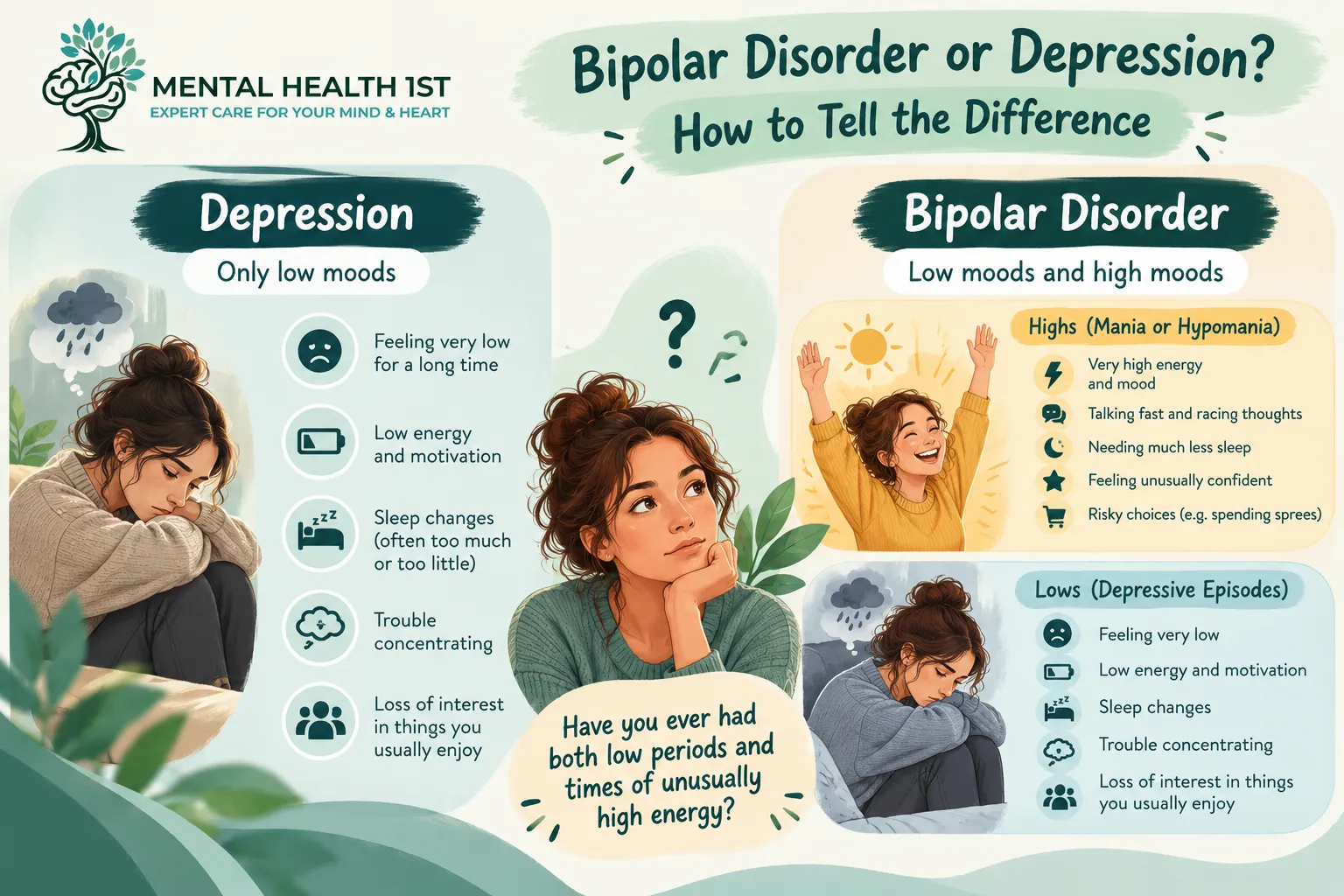
What is the difference between bipolar disorder and depression?
Here’s the answer in one line. Depression only has lows. Bipolar disorder has lows plus highs.
That’s the whole dividing line. A person with bipolar disorder has had at least one time of mania or hypomania in their life. A person with depression alone hasn’t.
Here’s the part that surprises people. The low times in bipolar disorder can look and feel the same as regular depression. Same sad mood. Same tiredness. Same trouble sleeping and focusing. You can’t always tell them apart just from how the lows feel.
So the question isn’t “how low do I feel?” It’s “have I ever had a stretch of feeling unusually high, wired or irritable?”
We have more on regular depression in our posts on depression vs. sadness and high-functioning depression.
What does a depressive episode in bipolar disorder look like?
A lot like regular depression. To count as a depressive episode, a person has five or more of these symptoms, and they’re strong enough to get in the way of daily life:
- feeling sad, empty or hopeless most of the day
- losing interest in things they used to enjoy
- big changes in weight or appetite
- sleeping too little or too much
- feeling tired or slowed down, or feeling restless
- feeling worthless or very guilty
- trouble focusing or making choices
- thoughts of death or suicide
People with bipolar disorder tend to spend more time in the lows than in the highs. Those lows can also be harder and more dangerous, with more thoughts of suicide than in other kinds of depression. That’s one more reason to get it checked.
If any of this sounds like you, our post on burnout or depression can help you sort out what’s what.
What is a manic episode?
Mania is a stretch of very high energy and mood that goes well past normal excitement. It’s the “ceiling” of the hallway.
During mania, a person might:
- feel super confident, even bigger than life
- need much less sleep and still feel full of energy
- talk fast and jump from idea to idea
- have racing thoughts
- get pulled off track by anything
- make risky choices, like big spending sprees
Some people feel angry and jumpy instead of happy. That counts too.
Mania is strong enough to cause real trouble at work, at school or at home. Sometimes a person needs to go to the hospital. In severe cases, a person may see or hear things that aren’t there. Doctors call that psychosis.
Having at least one manic episode is what points to bipolar I. A manic stretch in bipolar I lasts at least a week, unless it’s bad enough that the person ends up in the hospital sooner.
What is hypomania, and why do people miss it?
Hypomania is a lighter version of mania. Same kind of symptoms, just not as strong.
It can actually feel great. You sleep less but feel fine. You get tons done. You’re talkative, funny, full of ideas. Friends might say, “Wow, you’re on fire this month.” People with hypomania often keep working and seeing friends just fine.
So who would bring that up to a doctor? Almost nobody. It feels like a good stretch, not a symptom.
That’s exactly why hypomania gets missed. Then the crash comes, the low mood shows up, and the person goes in saying only “I’m depressed.” The provider treats depression. The highs never come up.
Bipolar II is the type with hypomania and depression, but never a full manic episode. A simple way to check is to ask yourself: have I ever had four or more days in a row when I felt unusually energetic or irritable, and not like myself?
Why does bipolar disorder get mistaken for depression?
A few reasons stack up.
The lows look the same. There’s no blood test or brain scan that shows bipolar disorder. Providers can’t take a picture and see it.
The highs get left out. People don’t say “I felt amazing in March” when they’re sitting in the office feeling awful in June. It doesn’t seem related.
Lows are also when most people finally ask for help. Many people with bipolar disorder are first seen for depression alone. The provider treats what they see.
And bipolar II is the easiest to miss. When hypomania goes unnoticed or unreported, it can get called major depression.
So a careful provider asks about the highs, even if you only came in for the lows. If yours never has, you can bring it up yourself.
This kind of mix-up is common in mental health. Our post on why mental health conditions get confused shows a few others.
What are the signs it might be bipolar disorder and not depression?
None of these prove anything on their own. But a few clues make a provider look closer.
One is stretches of high energy. Days when you felt wired, super productive or unusually irritable, and it wasn’t just a good mood.
Another is needing way less sleep. Not because of a stressful week. You slept three or four hours for days and felt fine, even energized.
Mood swings over time matter too. Your mood hasn’t just stayed low. It has gone in both directions.
Family history counts. Bipolar disorder is more common in people who have a parent or sibling with it. Providers also ask about relatives with depression.
So does starting young. Symptoms often begin in the teens or early adult years. The average starting age is around 25, though some people are diagnosed later.
And so do racing thoughts, fast talking or risky choices during a stretch that other people noticed.
If a few of these fit, tell your provider. Even if it felt good at the time.
What questions can you ask yourself?
Grab a quiet minute and think through these. You’re not diagnosing yourself. You’re collecting facts you can share.
Has there ever been a time, lasting four days or more, when I felt more energetic or more irritable than usual? Did other people notice? Did I need a lot less sleep and still feel fine? Did I talk faster, think faster or take on way more than usual? Did I spend money or make choices I later regretted?
Then think about the lows. How often do they come? How long do they last? Did they come right after a high stretch?
Last, think about family. Has a parent, brother, sister or other close relative been told they have bipolar disorder or depression? What about relatives who were called “moody” or “up and down” for years?
Write your answers down and bring them to the visit. The answers can save a lot of time.
Can depression medicine make bipolar disorder worse?
It can. That’s a big reason to get the right diagnosis.
Medicines for depression, when taken alone, can sometimes trigger mania in a person who has bipolar disorder. In some cases they can also push moods to swing faster. When a depression medicine is part of the plan for bipolar disorder, it’s usually used alongside a medicine that steadies mood.
This is general information, not advice about your own medicine. If you take anything for depression right now, don’t stop it on your own. Stopping suddenly can cause its own problems. Talk with your prescriber first.
If you want to know what a medication visit looks like, read what psychiatric medication management is.
How does a provider tell bipolar disorder from depression?
They talk with you. A lot. There’s no single test.
A careful visit usually includes a long talk about your mood over time, not just this week. Providers ask about the highs, the sleep changes and the stretches that felt “off” in a good way.
They’ll ask about family. Does anyone in your family have bipolar disorder or depression?
They’ll check for other causes. Some medical problems can cause mood changes, so a provider may order lab tests or review your health history.
And they may want input from people who know you. With your permission, a family member or close friend can describe things you might not notice, like how you acted during a high stretch.
Some providers also ask you to track your mood, sleep and other things every day for a while. That daily record can show a pattern that’s hard to remember later.
At Mental Health First, a psychiatric evaluation is where this kind of full history gets taken, in Miami Lakes in person or by telepsychiatry.
What should you track before an appointment?
A simple mood diary helps more than you’d think. It doesn’t need to be fancy. A notes app works.
Each day, write down a few things. How was your mood from one to ten? How many hours did you sleep? How was your energy? Did you feel unusually irritable, wired or slowed down? Did anything big happen, like a fight, a loss or a change in medicine?
Do this for a few weeks if you can. Bring it along. Seeing the days laid out in a row can show things your memory skipped, like a week of four hour nights that you forgot about.
Don’t worry about getting it perfect. A messy diary still beats none.
What are the types of bipolar disorder?
There are three main ones.
Bipolar I has at least one manic episode. The highs are full-on. Depression usually shows up too, but it isn’t required for the diagnosis.
Bipolar II has at least one stretch of hypomania and at least one major depressive episode. No full mania.
Cyclothymia is many ups and downs that last two years or more. Both the highs and the lows are milder than in the other two.
Some people have symptoms that don’t fit neatly into any of these. That’s okay. A provider can still help.
You’ll find more on our bipolar disorder treatment page in Miami Lakes. Bipolar disorder is also one kind of mood disorder, along with depression.
What else can look like bipolar disorder?
A few conditions get tangled up with it.
Bipolar disorder with psychosis can be wrongly called schizophrenia, because both can involve hearing or seeing things that aren’t there. It can also be mistaken for borderline personality disorder. And in children, ADHD can get in the way of an accurate diagnosis.
It goes the other direction too. ADHD can share things like restlessness, racing thoughts and trouble focusing. If your focus problems have been there since childhood, look at our post on ADHD symptoms in adults.
Mood changes can also come from medical problems, from drugs and alcohol, and from big life stress. So a good evaluation looks at the whole story.
Our page on schizophrenia treatment in Miami Lakes explains how psychosis is treated.
Who gets bipolar disorder, and what causes it?
About 3 in 100 adults in the U.S. have it in a given year. Men and women get it at about the same rate.
Nobody knows the exact cause. Researchers think genes play a part, because it runs in families. Differences in how the brain works may matter too. Having a parent with bipolar disorder doesn’t mean you’ll get it, though.
Stress and hard events can set off an episode in someone who’s at risk. So can drug and alcohol use, and big losses or trauma.
It’s no one’s fault. It’s not weakness, and it’s not a “bad attitude.”
Can anxiety, ADHD or other conditions show up with bipolar disorder?
Yes, and often.
Anxiety, ADHD, PTSD, eating disorders and substance use can all happen alongside bipolar disorder. That’s part of what makes it tricky. A person can have more than one thing going on, and each one needs a look.
Sleep changes are a big part of bipolar episodes. If sleep is part of your story, see why anxiety keeps you awake and why you may feel so tired all the time. We also have care for anxiety.
What happens if bipolar disorder isn’t treated?
It doesn’t get better on its own. Without treatment, the episodes can come back and cause bigger problems.
Those can include trouble with drugs or alcohol, money and legal problems, strained relationships, and poor work or school performance. It can also raise the risk of suicidal thoughts and attempts.
None of this is meant to scare you. It’s the reason an early, correct diagnosis helps so much. The earlier treatment starts, the better a person can protect their job, their relationships and their health.
How is bipolar disorder treated?
Bipolar disorder usually needs treatment for the long run. The good news is that it can be managed, and many people live steady, full lives with the right care.
Treatment usually has a few parts.
Medicine is one. Mood stabilizers are a main group. Some people also take a type of medicine called an antipsychotic. Depression medicine may be used too, but usually only alongside one of the others. Finding the right match can take a few tries, so don’t get discouraged if the first one isn’t perfect.
Talk therapy is another. Several kinds help. They teach you to spot early warning signs, keep a steady routine for sleep and meals, and work through stress. Family sessions can help the people around you understand what’s going on.
Daily habits help too. A steady sleep schedule and regular routines matter, because big sleep swings can be an early sign of an episode.
For people who don’t get better with medicine alone, doctors may talk about other options, like brain stimulation treatments. Those are used in specific cases.
Staying with treatment matters a lot. Skipping care can lead to harder episodes.
If you ever have thoughts of hurting yourself, call or text 988 any time, day or night. That’s the Suicide and Crisis Lifeline.
How can family and friends help?
Loved ones often notice changes first. A person who is starting to feel high may sleep less and talk faster. A person sliding into a low may pull back and seem tired.
If you’re worried about someone, a calm talk works better than an argument. Describe what you’ve seen, like “You’ve barely slept in three days,” instead of labeling them. Encourage them to see a provider, and offer to help set up the visit.
With the person’s permission, family members can also share what they’ve noticed with a provider. That can make the evaluation more accurate. Some therapy programs involve the family too.
Learning about the condition helps everyone. It can make it easier to spot early signs and to stay calm when things get hard.
Can people with bipolar disorder live a normal life?
Yes. With ongoing care, many people have long steady stretches between episodes and do well at work, school and home.
Some people have episodes often, and others go a long time feeling fine. Episodes usually last days to weeks. The plan can change over time as life changes. What matters is staying connected to care and speaking up early when something feels off.
How do I get checked for bipolar disorder in Miami Lakes?
If you’ve been treated for depression and things don’t add up, or if you recognize a high stretch in your own life, the next move is a real evaluation.
Mental Health First offers psychiatric medication management and depression treatment in Miami Lakes, plus bipolar disorder treatment. You can read about our provider first if you’d like.
To set up a visit, contact us.