

 Post by

A mood disorder is a mental health condition where your emotional state stays off for a long time. Depression is the one most people know. Bipolar disorder is another. In both, the mood isn’t a passing thing. It sits there, it runs most days, and it starts to push around your sleep, your work, your family, the way you see yourself.
Everybody has bad weeks. Plenty of people snap at the people they love now and then. That’s life. A mood disorder is something else. It’s when the low (or the high) doesn’t match what’s going on around you, or it just won’t lift when things get better.
And here’s the part worth hearing early: it’s treatable. With the right care, most people with a mood disorder go on to live full, productive lives.
What is a mood disorder?
It’s a group name. Doctors use it for conditions where the mood itself is the main problem.
Depression sits in that group. So does bipolar disorder, and so does a milder, longer running version of mood swings called cyclothymia. What ties them together is that the trouble starts with how you feel, day after day, and not with something else that’s throwing your mood off.
Here’s the difference between a mood and a mood disorder. A mood has a reason. You get bad news, you feel low, a few days pass, you feel better. A mood disorder doesn’t always need a reason, and it doesn’t leave on schedule. It can show up during a good stretch of life. It can stay after the hard thing is over.
It’s also a real medical condition. Not weakness. Not a bad attitude. Not “you just need to try harder.” Nobody tells a person with diabetes to snap out of it.
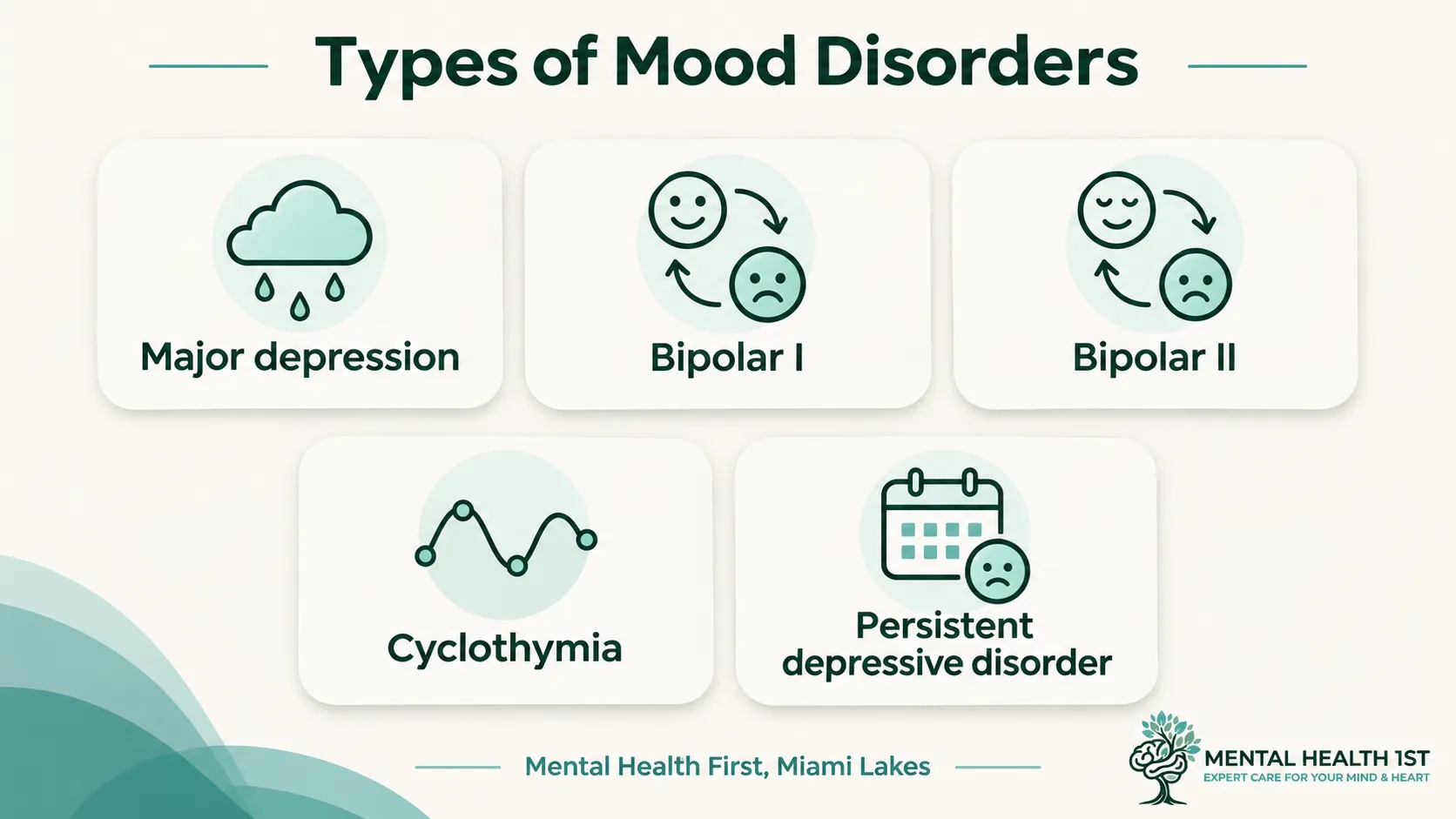
What are the types of mood disorders?
The main ones are major depression, bipolar I, bipolar II and cyclothymia. A few other forms exist too, which we’ll get to.
Major depression is the heavy one. It’s a low mood, or a loss of interest in things you used to like, that lasts most of the day, nearly every day. Most people who have one episode have more than one over the years. How it’s different from regular sadness is its own topic, and depression vs sadness covers it. If you want to know what care looks like here in town, see our depression treatment in Miami Lakes page.
Bipolar disorder swings. There are depressive episodes, and there are highs. A full high is called mania, a milder one is hypomania. Bipolar I means at least one real manic episode, which can get severe enough that a person loses touch with reality. Bipolar II means depression plus hypomania, but never a full manic episode. Don’t read “II” as “less serious,” by the way. The lows in bipolar II can be deep. For more, see bipolar disorder treatment in Miami Lakes.
Cyclothymia is the quieter cousin. Lots of mild highs and mild lows, on and off, for at least two years. Never quite reaching full depression or full mania. But exhausting all the same, because it never really lets up.
Then there’s persistent depressive disorder. It’s a long, grinding kind of depression. Symptoms come and go over years, and relief rarely lasts. It’s usually not as severe as major depression on a given day, but the length of it wears people down, and a major depressive episode can land on top of it.
There’s also a seasonal pattern. Some people get depression that comes back around the same time each year, usually starting in fall and easing in spring. Less often it runs the other way, in summer.
And mood symptoms can come from outside the brain. Drugs, alcohol and some medical conditions can cause them. That’s one reason a full check-up matters before anyone puts a label on it.
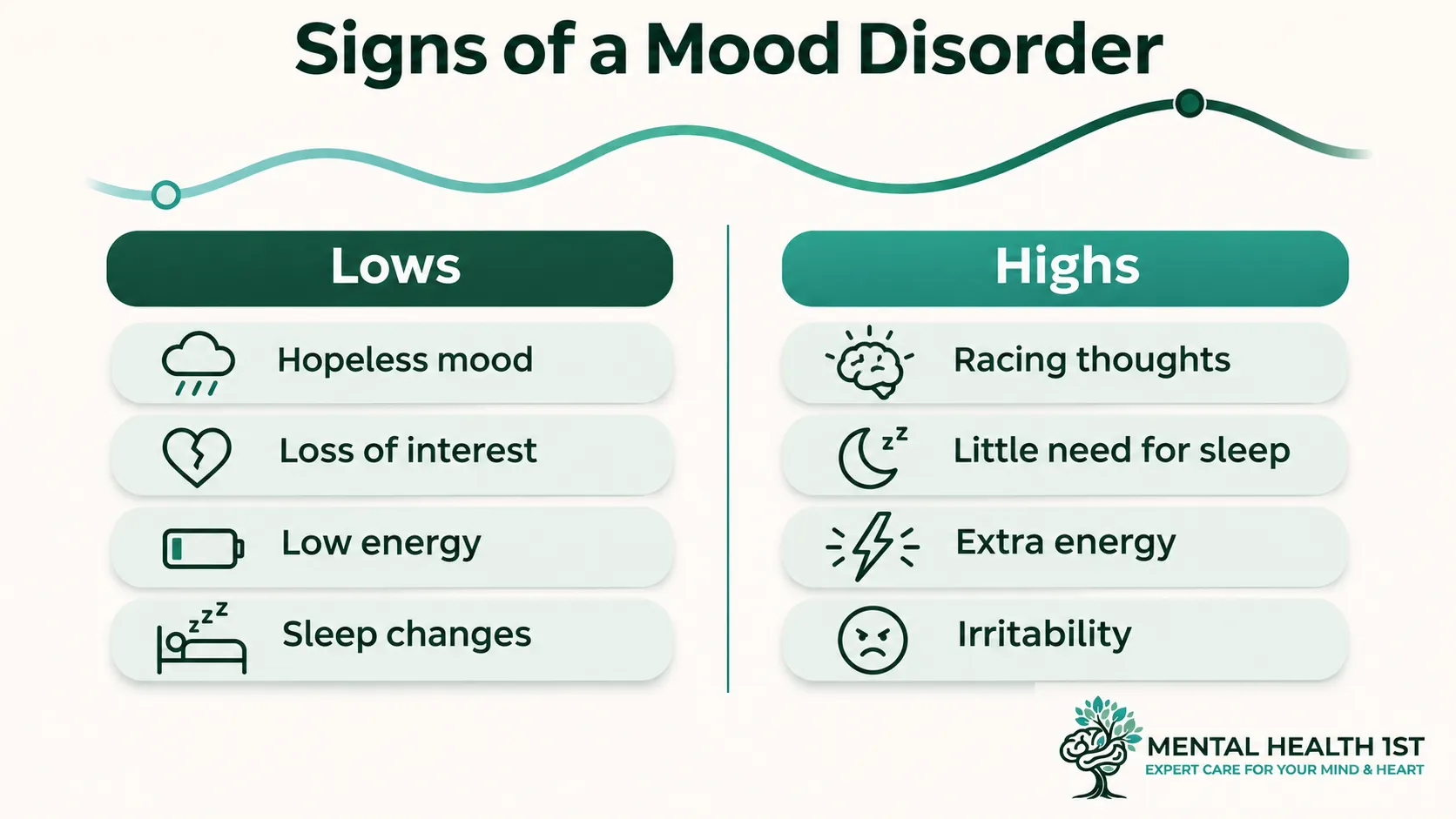
What are the symptoms of a mood disorder?
It depends on which way the mood is going.
On the low side, the biggest sign is a sad, empty or hopeless mood that stays. Often it comes with losing interest in things you’d normally enjoy, and that part can be the loudest sign of all. You stop caring about the show you loved. The friend’s invite sounds like work. Sleep goes sideways, either too much or too little. Energy drops. Appetite and weight can change. You might feel guilty about everything, or worthless, or like a burden. Focus gets hard. Even small choices feel big. Some people feel slowed down, others restless. Aches and pains with no clear cause show up too, like headaches or a sore back. And thoughts of death or suicide can come in.
Anger is on that list too, and people forget it. Irritability over small things is a common sign of depression. If you’ve been snapping more than usual and can’t figure out why, it’s worth asking whether the real problem is mood. Why am I so tired all the time and high-functioning depression are good reads if depression doesn’t look the way you expected.
On the high side (mania or hypomania), you feel way more energetic, wired or “on” than usual. You need much less sleep and don’t feel tired. Words come fast. Thoughts race. Some people get overconfident, take big risks or spend money they don’t have. And plenty of people don’t feel happy at all in a high. They feel irritable and jumpy. In severe mania, some people hear things that aren’t there or hold beliefs that aren’t true.
If you’re having thoughts of hurting yourself right now, call or text 988, or call 911. Don’t wait for an appointment.
What is the difference between depression and bipolar disorder?
Bipolar disorder has highs. Depression doesn’t.
That’s it, really. With depression alone the mood stays low. With bipolar disorder it moves between low and high. But here’s the catch. Most people walk in during a low. They describe the low. The highs? Those felt good, or looked like a really productive month, so nobody mentions them. And the person gets treated for plain depression.
That can go badly. Treatment for the two isn’t the same, and a medicine that helps depression can make bipolar disorder worse if it’s used without care. So the history matters a lot. If you ever went days needing hardly any sleep and still felt great, or did things that weren’t like you, say so. Even if it seems unrelated. Our post on bipolar disorder or depression goes through how to tell them apart.
How long do episodes last? In bipolar disorder, a mood episode usually runs a few days or weeks at a time. In between, some people feel steady for weeks, months, even years. That’s another reason it gets missed. The good stretches look like recovery.
Do mood disorders look different in kids, teens and older adults?
They can. Age changes the picture.
In children and teens, depression often looks like irritability more than sadness. Falling grades, pulling away from friends, school trouble, and sometimes self-harm can be the signs a parent sees first. In older adults, it can look like tiredness, aches, or memory changes, and that’s a big reason it gets missed. People assume it’s just aging, or a physical illness, and nobody thinks to ask about mood.
So if someone in your family has changed and you can’t put your finger on why, mood is a fair question to raise. Age doesn’t rule it out. Neither does being busy, successful or “fine on paper.”
What causes mood disorders?
Nobody knows the exact cause. It’s a mix, and it’s different for everyone.
Researchers point to the brain: differences in how it’s built and how its chemicals work. They point to genes. They point to hormones, and to the things that happen to you. None of them works alone.
Mood disorders do run in families. If a parent or sibling has bipolar disorder, your chance of it goes up. A family history of depression, bipolar disorder, alcoholism or suicide counts as a risk factor too. But risk isn’t destiny. Plenty of people with a family history never get one. Is depression genetic goes into that.
Life matters as much. Abuse, losing someone you love, a hard relationship, money stress, a childhood that was hard. Alcohol and drug use can bring on episodes or make them worse. Serious illness can too, and a few medicines. Hormone shifts count, like the ones around pregnancy, after having a baby, or with thyroid problems. If hormones might be part of what’s going on, perimenopause or depression shows how easily the two get tangled.
Anyone can get one. Age, race, income and schooling don’t protect you.
How common are mood disorders?
Very. Depression alone affects hundreds of millions of people around the world. The World Health Organization estimates about 5.2% of adults worldwide had depression in 2023, and it’s about 1.5 times more common in women than in men.
In the United States, about 8.3% of adults had at least one major depressive episode in 2021. That’s around 21 million people. Young adults ages 18 to 25 had the highest rate, at 18.6%. Bipolar disorder is less common but it hits hard: about 2.8% of U.S. adults had it in the past year, and most of them had serious impairment.
Here’s the number that stands out. In 2021, about 61% of U.S. adults with a major depressive episode got treatment. So roughly four in ten didn’t. In high-income countries overall, only about a third of people with depression get mental health treatment. Not enough providers, stigma, and plain not knowing where to start all play a part.
If that’s you, you’re in very large company. Including the part about waiting.
How is a mood disorder diagnosed?
By talking, mostly. There’s no brain scan or blood test that says “mood disorder.”
A provider asks about your mood, sleep, energy, appetite and thoughts. How long has it been going on? What does a normal day look like? What makes it better, what makes it worse? They ask about your family. They ask about alcohol and drugs. With your okay, they may also talk to someone close to you, because family and friends sometimes notice things you don’t.
Sometimes there’s also a physical exam and a few lab tests, like a blood count or a thyroid check. That’s not because a blood test finds a mood disorder. It’s to make sure something physical isn’t causing the symptoms. Your provider might also ask you to track your mood and sleep every day for a while. That record is gold for spotting patterns, especially highs you’ve half forgotten.
Providers use a standard set of criteria for depression. And they’re careful about it, because bipolar disorder and persistent depressive disorder can look a lot like major depression. Getting the right diagnosis is what decides which treatment you get.
At Mental Health First in Miami Lakes, the starting point is a psychiatric evaluation. It’s a conversation, a thorough one, and you walk out knowing what’s going on and what to do next.
What is the best treatment for a mood disorder?
There isn’t one best treatment. There’s the right fit for you. It’s usually medicine, talk therapy, or both.
For depression, mild cases may get better with talk therapy, exercise and support. For moderate or severe depression, a mix of talk therapy and medicine is often recommended. Therapy comes in different kinds, and plenty are effective, from cognitive behavioral therapy to ones that focus on relationships or problem solving. Medicine may need several weeks to work fully, and sometimes finding the right one means trying more than one. Don’t stop an antidepressant on your own, either. Quitting suddenly can bring on withdrawal-like symptoms or make depression worse. If depression hasn’t improved with medicine, there are other options, like brain stimulation treatments. A provider can tell you if they make sense for you.
For bipolar disorder, medicine is usually the base. Mood stabilizers are the foundation, and sometimes another kind of medicine that also helps keep mood steady. Talk therapy is a big part of it too, including therapy that helps build a steady daily routine, cognitive behavioral therapy, and teaching you and your family what to watch for. Bipolar disorder can’t be cured, but it can be managed. That’s a long game. Medicine often has to continue even when you feel great, because stopping can bring symptoms right back.
Habits help, but they back treatment up. They don’t replace it. Regular sleep. Moving your body. Less alcohol, no recreational drugs. Staying in touch with people. Putting off big life decisions when you’re in a low. Supplements and other natural remedies shouldn’t replace treatment. Talk to your provider before taking any, because some interact with medicine.
And depression, specifically, is not something most people can treat alone. That’s not a failure. It’s just how the condition works.
If medicine is part of your care, you’ll want someone who follows up and adjusts as you go. That’s what psychiatric medication management in Miami Lakes is for, and what is psychiatric medication management explains how it works. You can be seen in person in Miami Lakes or through telepsychiatry.
Can a mood disorder go away on its own?
Sometimes the mood lifts for a while. But waiting for it to disappear is a gamble.
Depression can ease without help. It can also come back, and untreated depression tends to get worse. It can lead to physical illness, anxiety, drinking or drug use, trouble at work and at home, self-harm, and in the worst cases, death by suicide. Bipolar disorder doesn’t get better on its own at all.
The hopeful side is just as real. With treatment, most people with depression can make a full recovery. And the sooner you get help, the sooner you tend to feel better.
Can a mood disorder affect your body?
Yes. Mind and body aren’t separate systems.
Mood disorders raise the risk of other health problems, including heart disease and diabetes. They cause physical symptoms of their own too: constant tiredness, poor sleep, appetite swings, aches. Heavy drinking and low activity can add to the problem, and depression itself makes it harder to look after yourself, so it can loop.
Mood disorders also love company. Anxiety often shows up alongside them. If worry and low mood come as a pair, our anxiety treatment options post and the anxiety treatment in Miami Lakes page are worth a look. And if you can’t tell which condition you’re dealing with, that’s normal. Why mental health conditions get confused explains why.
When should you get help for a mood disorder?
When it’s more than a rough patch. That’s the simple rule.
If your mood has been low or swinging for more than a few weeks, that counts. If it’s hurting your sleep, your job, your relationships, or your safety, that counts. And if you’ve been white-knuckling it alone and it’s not working, that counts most of all. Not sure how to start? Tell someone you trust. It can make the first step feel smaller.
Get help sooner if your sleep or appetite have changed a lot, if you’re leaning on alcohol to cope, or if you feel hopeless. And not sure whether what you’re dealing with is serious enough? When to get help for your mental health can help you decide.
If you ever feel like you might hurt yourself, call 911, or call or text 988, the Suicide and Crisis Lifeline. It’s free and open all day, every day. You don’t have to be sure of anything to call.